On This Page
Rev. Hermann Wilhelm Fiegenbaum
1824 — 1906
Biographical Material & Chronology
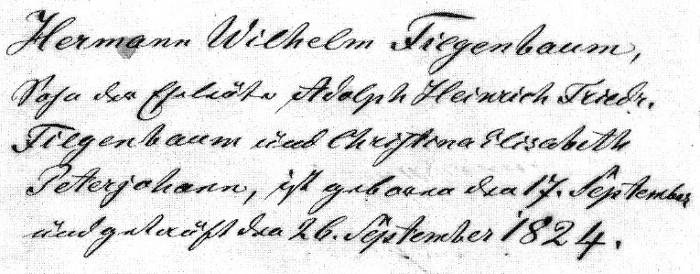
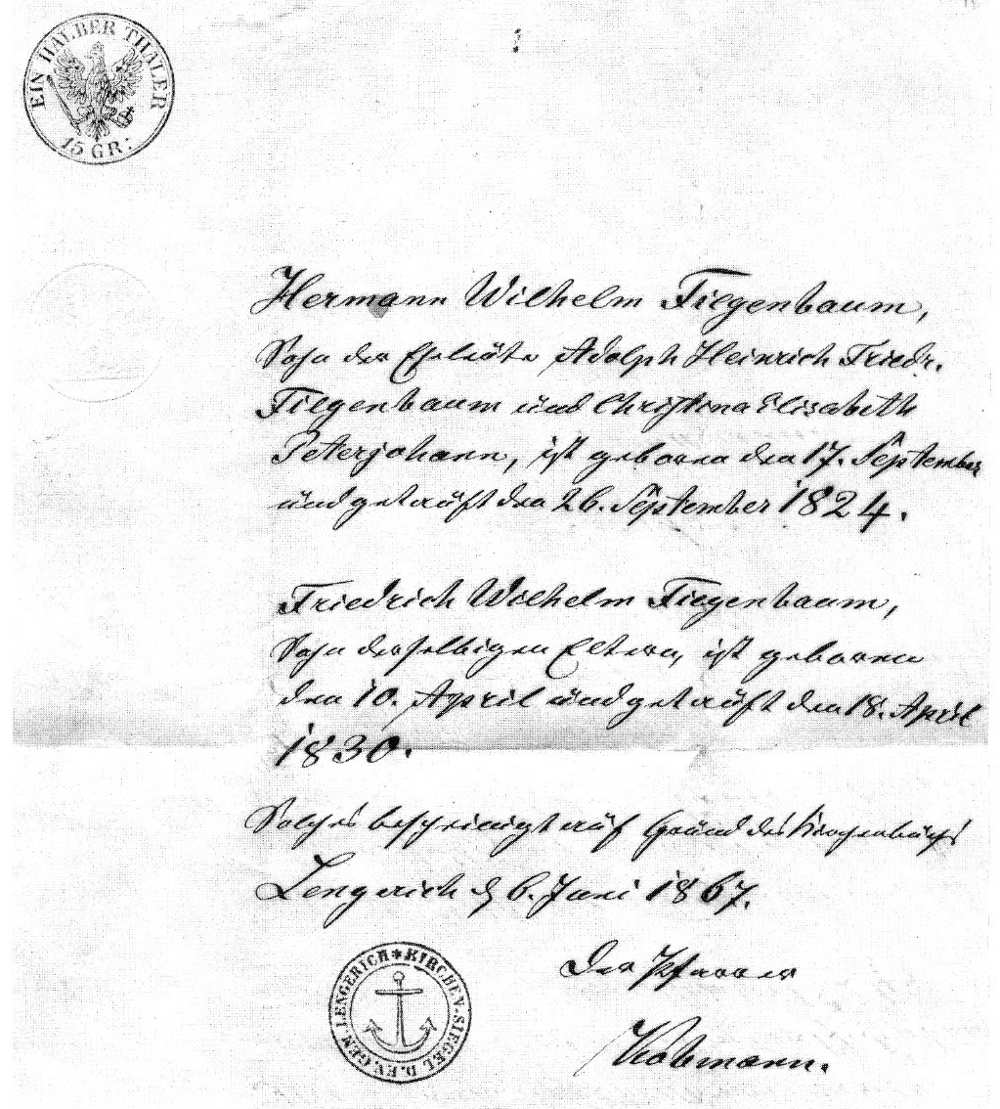
With the cursor on the image, click the "Maximize" icon  if visible in the lower-right corner to view full size.
Transcription:
Translation:
This paragraph is taken from a letter written in June 1867 by the pastor of the evangelical church at Lengerich, Province of Westphalia, Kingdom of Prussia. In response to a inquiry from the Fiegenbaum family in Madison County, Illinois, Rev. Kolemann (spelling?) had consulted the registers of the church to confirm the births of Hermann Wilhelm Fiegenbaum and his brother, Friedrich Wilhelm Fiegenbaum.
Experience of William Fiegenbaum
I was in my tenth year when my parents concluded to emigrate to America. While we remained at the tavern in Bremen, I found an old Hymn-Book, in which I read the following lines:
"He who seeks for earthly treasures
Can not my disciple be."
This so affected my heart that I wept aloud, and showed the lines to my father, and told him we were not Christ's disciples, for we were seeking earthly treasures. I was, however, comforted by my parents when they told me that the hymn was not the word of God, but man's composition.
In my school years, from twelve to sixteen, I often thought if all these people, who call themselves Christians, are so, then the Bible can not be true. The time of my catechetical instruction was very sinful part of my life; yet my conscience waked up as I received the holy sacrament, and condemned me for having taken it unworthily, and I went home with a load of sin upon my heart. Still I had a desire to partake of this holy sacrament worthily.
There was a report of some German Methodists in Ohio who were said to have fallen from the faith. Finally, a number of German Methodists came to Missouri; but the preachers were hated and persecuted, and, in many places, deprived of the privilege of preaching. Yet my parents opened their house and allowed them to preach in it. After this I went to St. Louis, and one evening went to the Methodist church. The sermon awakened me to a sense of my lost condition. The word was "quick and powerful, and sharper than a two-edged sword, piercing to the dividing asunder of joints and marrow, and was a discerner of the thoughts and intents of the heart." My heart was very affected, and I at once resolved to join the Methodist Church. Now a voice, as from my heavenly Father, came to me, to repent, return, and be converted; and to this was added the exhortation of my brother and sister. This induced me, on the next Sabbath, to go to the church again. After the sermon there was prayer meeting; but my heart remained cold and indifferent. While penitents were kneeling around the altar, I was induced by curiosity to go up close and see who it was that cried so earnestly for the pardon of his sins. It was my brother, who had previously been a violent persecutor of the children of God. He lay there pleading for mercy, while the pious were offering up prayers for his salvation. I was at once convicted of sin, and sought to meet with the children of God. I spent fourteen days seeking for pardon; others prayed with me; but though thus seeking I could not find.
On the following Sabbath I went again. This was a day of the Lord to my soul. The preacher, Rev. C. Jost, took for his text, "Come unto me all ye that labor and are heavy-laden, and I will give you rest." After the sermon it was asked how it was with me, and I was told that I must seek earnestly by faith; for the "kingdom of God is not meat and drink, but righteousness, peace, and joy in the Holy Ghost." This I experienced, indeed, when I lay down in the evening to sleep, and offered up my soul to God, that he might seal it with the spirit of promise to the day of redemption. The joy that I found in a union with the Father, Son, and Holy Spirit, is not to be fully expressed by human tongue. It was now my earnest desire to live near to the Lord, and to follow after holiness, without which no one shall see the Lord.
I had frequent impressions that I should preach, even previous to my conversion, and these impressions increased ten-fold afterward. The responsibility of the ministerial office for some time deterred me; yet my eyes were opened to see how all men had corrupted their way before the Lord, and I had an abiding impression on my mind of the wonderful love of God, which he manifested to the human family. I was often so affected that I went to others, and told them of their danger in neglecting their salvation. My heart was at the same time filled with joy and sorrow - the former from a view of God's goodness, the latter from the view of man's lost condition.
The impression that I should preach grew so strong that I told some of my friends of it; and they exhorted me not to resist this impression. At first I felt a great struggle within, yet I was convinced that it was my duty to call sinners to repentance. I finally resolved to devote myself wholly to the service of the Lord. Now my soul was satisfied, and the Lord strengthened me in knowledge and in his grace and love to him. Soon after, I received license to preach. At my first efforts the Lord strengthened and blessed me. I commenced my labors in March, 1848, in the name of God. Since then I have seen many come from darkness to light. May the Lord keep us all faithful, and bring us at last to praise him before his throne!
Source: Adam Miller, compiler, Experience of German Methodist Preachers, edited by D. W. Clark (Cincinnati: Methodist Book Concern, for the author, 1859); pages 275-278.
The role of itinerant missionaries in the family's life in Missouri is also described in a similar essay written by Wilhelm's brother, Heinrich Hermann Fiegenbaum, in an autobiographical sketch written by his sister, Marie Wilhelmine (Fiegenbaum) Winter, and in an article about the Fiegenbaums, published in the St. Louis Post Dispatch in 1898.
Another brother, Friedrich Wilhelm Fiegenbaum, wrote a less formal but more impassioned statement of his experiences as a pastor in the German Methodist Episcopal Church.
Dalton, Mo.
Im März 1847 kam Br. Wilhelm Fiegenbaum nach Brunswick, Mo., als erster Missionar, um die Deutschen aufzusuchen und ihnen das Evangelium zu predigen. Die ersten Gottesdienste wurden in einem Kuhstall gehalten.
Dalton, Mo.
In March 1847, Brother Wilhelm Fiegenbaum came to Brunswick, Mo. as its first missionary, to seek out the Germans and preach the gospel to them. The first worship service was held in a cow shed. 1
Source: Otto E. Kriege, Gustav Beker, Matthäus Herrmann, and T. L Körner, Souvenir der West Deutschen Konferenz der Bischöflichen Methodistenkirche (S.l.: the Conference, 1906); p. 64. Transcription & translation by J. Mark Fiegenbaum.
Notes
-
Fledgling congregations often met in any available space that might accommodate them. Someone's home or a school might be a little less rough than a farm shed. In an interview with a reporter for the St. Louis Post-Dispatch in 1898, Hermann Wilhelm explained that his parents' invitation to a Methodist evangelist to preach in their home when no other place as available was a crucial event in the family's involvement in the Methodist Church.
The German Methodist Episcopal Church
by Rev. Wm. Schwind
HIGHLAND 1
It was in the year 1836 when some of the leading minds in the Methodist Episcopal church in the United States deemed it practicable to establish a domestic mission among the Germans. The movement, though slow at first in forming congregations, met with ultimate success and was carried on by the church with much zeal and activity. From Ohio and Pennsylvania where it began it spread westward.
As early as 1845, the Rev. Wm. Hemminghaus, a German Methodist preacher, went from Mascoutah, St. Clair county, to Highland, to preach to the Germans then residing there. He was one of the early pioneer preachers among the Germans in Illinois, and died at Beardstown while yet young.
He was succeeded in 1846 by Rev. Chas. Koeneke, and the first society was organized in that year. Some of the first members were, Michael Molet, John Zimmermann, Philip Gruen, J. Miller and C. Kluge. As it soon appeared necessary to have a house for worship, a deliberative meeting of the society was held on the 14th of December, 1846, which decided that a church should be built; but owing to circumstances it was not accomplished until a few years later.
Rev. Charles Koeneke was succeeded by Rev. Louis Kunz in 1847. Rev. Wm. Fiegenbaum 2 followed in 1848. In the fall of the same year the building of a church was commenced and carried on until it was under roof. Its completion was delayed till the following spring. It was dedicated on the 26th of June, 1849, by Rev. Henry Koeneke, presiding elder. The church is 40 by 30 feet, two stories high, with steeple and bell. The lower story was built of rough stone; the upper story was built in partnership with the American Methodist, which relation is still sustained. Its value is about $2,000. It is still used for public worship and is of interest to many yet living who often went to Highland at those times to attend quarterly meetings which always were of great interest. Some of the first members were, F. Kandert, J. Kirsher, Gallus Rutz, Henry Becker, J. Kaeser, Charles Grundenberg, and C. Britt. The mission at that time already embraced a large territory and many appointments. It included Edwardsville, Fosterburg, Staunton, Looking Glass Prairie, Beaver Creek, Blackjack, Smooth Prairie, Silver Creek, Ridge Prairie, The Bluffs, Moro and Upper Alton. The membership in the whole field of labor numbered 67 at the time the church was dedicated. Rev. Wm. Fiegenbaum was in charge of the mission with two assistant preachers. 3 They were Rev. J. Keck and Rev. Herman Koch, who is now President of Central Wesleyan College, Warrenton, Mo. The latter taught school at Highland, besides preaching regularly at several appointments.
Great and exhausting were the labors of those early pioneer preachers, but they felt themselves equal to almost any emergency. With heroic devotion to their work and self-denying determination, they shared the hardships and difficulties of the early German settlers. They were on horseback almost every day, seeking the lost sheep of the house of Israel, preaching in log cabins, school houses, and where ever they could get any hearers, many or few, to teach them the way of righteousness, expecting very little compensation but what the great Shepherd might please to give them at the great day. And their labors were not in vain. Many persons became converted and rejoiced in the experience of a new life.
When in the year 1849 the Cholera broke out, eight to ten persons died almost every day at Highland. Rev. Wm. Fiegenbaum was stopped on his rounds for fear he would spread the disease. But then he went to nurse the sick and dying, often day and night, for two months, administering faithfully to their bodily and spiritual wants. After that he resumed his labors and was eminently successful in building up the societies in Madison county. Several years later a new church was built at Beaver Creek, where a society still exits. Most of the above mentioned appointments are still places for public worship; they are either formed into separate organizations or connected with other charges.
The early history of Highland church is of more special interest, as it was the nucleus from which sprung most other societies in the county. Of its later history I have little knowledge. Its present membership is 70. It carries on two Sabbath-schools of about 100 scholars, 16 officers and teachers.
Source: History of Madison County, Illinois: Illustrated: with Biographical Sketches of Many Prominent Men and Pioneers (Edwardsville, Illinois: W. R. Brink & Company, 1882); pages 291-292.
This selection is from Chapter 14, "Ecclesiastical History;" from a section of the chapter entitled "The German Methodist Episcopal Church," written by Rev. Wm. Schwind.
Notes to Article on the German M. E. Church at Highland, Illinois
-
This is a brief historical sketch of the German Methodist Episcopal Church at Highland, Madison County, Illinois.
-
Rev. Hermann Wilhelm Fiegenbaum is often identified in the literature of the church by his middle name, in either its German (Wilhelm) or English (William) form.
-
It was not uncommon for frontier pastors in the Methodist Episcopal Church to have charge of a number of congregations at one time. This often necessitated a considerable amount of travel and hardship, which the author acknowledges in the next paragraph. Hermann Wilhelm Fiegenbaum's brother, Friedrich Wilhelm, also a minister in the German Methodist Episcopal Church, wrote to his children about his life as a circuit pastor (Reiseprediger, in German) and the patient sufferings of his wife. At this time in the development of the Church, pastors were frequently concerned with raising funds for the construction of a permanent place of worship.
The German Methodist Church [at Wisetown, or Beaver Creek, Beaver Creek Precinct, Bond County, Illinois] was built in 1865, and cost about $1,400. The society was first organized in 1850.... The first minister was Rev. W. Fiegenbaum, who organized the church....
Source: William Henry Perrin, History of Bond and Montgomery Counties, Illinois (Chicago, Illinois: O. L. Baskin, 1882); page 149.
On Wednesday, 4 June 1896, the annual meeting of the Old Settlers Union of Madison County was held at St. John's Methodist Episcopal Church at Edwardsville, Illinois. In the afternoon session of the gathering, some elderly members each spoke for about five minutes about their early experiences.
Rev. Wm. Fiegenbaum, who arrived in the county in 1834, told of the old market on the levee at the foot of Market street in St. Louis, and recited his pioneer experience as a Methodist preacher, one of his journeys being 245 miles to preach 16 times.
Source: The Edwardsville Intelligencer (Edwardsville, Illinois); Friday, 6 June 1896, page page 4, columns 4 & 5.
Although the account in the local newspaper reported that Rev. Fiegenbaum had arrived in the county in 1834, I believe this is not quite accurate. It appears to be true that his family did arrive in the U.S.A. in 1834, when Hermann Wilhelm Fiegenbaum was 10 years old, but by all accounts they settled in eastern Missouri, very likely in the southern part of St. Charles County, not far from the village of Femme Osage. It was probably here that Wilhelm's parents converted to Methodism in 1844. He followed suit a few years later and in 1848 was appointed the first resident pastor at Highland, Madison County, Illinois. I think this was his earliest appearance in Illinois.
Rev. Fiegenbaum spent the rest of his adult life in service to the German Methodist Epicopal Church. Many of his early charges, whether as a regular pastor or a presiding elder, did involve condsiderable travel over large areas of the countryside.
Wilhelm Fiegenbaum, der im Alter von 82 Jahren als superannuiertes Mitglied der St. Louis Deutschen Konferenz seinen Lebensabend in Edwardsville, Ill., zubringt, teilt in einigen Zeilen Folgendes über seine Wirksamkeit in dem Gebiet unserer Konferenz mit: "Die Chariton-Mission, später die Brunswick and Carrolton-Mission, wurde im März 1847 begonnen. Glasgow, Brunswick, Carrolton, sowie die Landsettlements in ihrer Nähe, wo Deutsche wohnten, wurden besucht. In 18 Monaten hatten sich etwa 65 Personen angeschlossen und in Brunswick und auf dem Lande bei Carrolton wurden Kirchen erbaut durch den 'jungen Kandidaten', wie Vater Köneke ihn nannte. Von September 1854 bis September 1856 war ich thätig als Vorstehender Aeltester des Missouri-Distrikts, der sich von Jefferson City bis hinauf durch Kansas und eine Ecke von Nebraska auf beiden Seiten des Missouri-Stromes erstreckte. In 1875 wurde ich nach Oregon, Mo., gesandt, welche Bestellung ich ein Jahr bediente."
Wilhelm Fiegenbaum, who at age 82 as a superannuated member of the St. Louis German Conference spends his evening years in Edwardsville, Ill. communicates in a few lines the following about his effectiveness in the area of our conference: "The Chariton Mission, later the Brunswick and Carrolton Mission, was begun in March 1847. Glasgow, Brunswick, Carrolton, as well as German settlements in the area, were visited. In 18 months about 65 people joined the church and in Brunswick and the area around Carrolton churches were built by the 'young candidate,' as Father Köneke called him. From September 1854 to September 1856, I was active as the presiding elder of the Missouri District, which stretched from Jefferson City through Kansas and a corner of Nebraska along both sides of the Missouri River. In 1875, I was sent to Oregon, Mo., where I served for one year."
Source: Otto E. Kriege, Gustav Beker, Matthäus Herrmann, and T. L Körner, Souvenir der West Deutschen Konferenz der Bischöflichen Methodistenkirche (S.l.: the Conference, 1906); page 20. Transcription & translation by J. Mark Fiegenbaum.
Wilhelm Fiegenbaum.
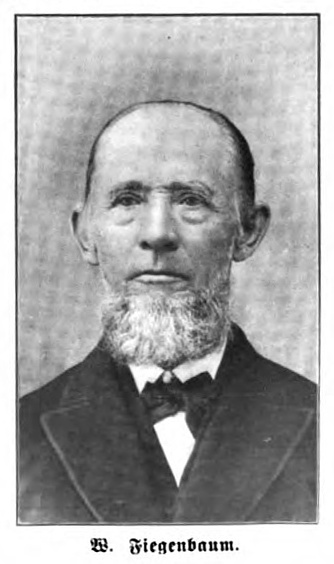
Dieser alte wohlbekannte Veteran der St. Louis Deutschen Konferenz, schreibt über seinen Lebenslauf in wenigen, drastischen Worten Folgendes: Ich wurde am 17. September 1824 in Westfalen, Deutschland, geboren and kam zehn Jahre später mit meinen Eltern nach Amerika. Im Jahre 1845 wurde ich, unter der Wirksamkeit von Br. Kaspar Jost, zu Gott bekehrt und zwei Jahre später als Prediger in die Illinois-Konferenz aufgenommen. Bis zum Jahre 1891 habe ich ununterbrochen das herrliche Evangelium von Christo gepredigt. Vor vier Jahren durfte ich mit meiner Gattin das Fest der goldenen Hochzeit feiern (1899). Der Herr schenkte uns acht Kinder, zwei von ihnen sind in der Ewigkeit. Ich und meine Gattin sind nun alt und gebrechlich, und deshalb auch lebenssatt, aber wir sind glücklich in Gott und danken ihm für seine gnädige und wunderbare Führung. Ausgedient und alterschwach sitze ich jetzt daheim in der Ecke als superannuierter Prediger im achtzigsten Lebensjahre, doch es ist alles wohl.
Wilhelm Fiegenbaum.
This old, well-known veteran of the St. Louis German Conference, wrote the following about his personal record in a few, spare words: I was born on 17 September 1824 in Westphalia, Germany and came to America ten years later with my parents. In 1845, under the influence of Brother Kaspar Jost, I was converted to God and two years later admitted to the Illinois Conference as a preacher. Unceasingly until 1891, I preached the glorious Gospel of Christ. Four years ago my wife and I were able to celebrate our golden wedding anniversary. 1 The Lord graced us with eight children, two of whom are in eternity. My wife and I are old and frail, and thus, world-weary, but we are blessed by God and thank Him for his gracious and wonderful guidance. Obsolete and decrepit, a superannuated preacher in his eightieth year, I am now sitting at home in the corner, but all is well.
Source: Jubiläumsbuch der St. Louis Deutschen Konferenz, edited by E. C. Magaret, Friedrich Munz, and Geo. B. Addicks (Cincinnati, Ohio: Jennings und Graham, [1905?]); pages 391-392. Transcription & translation by J. Mark Fiegenbaum.
Notes
-
The 50th wedding anniversary was celebrated in 1899.
Chronology
Tracking Hermann Wilhelm Fiegenbaum and his family over the course of his career as a Methodist minister throughout the middle-western states is no easy task. Despite scattered references and sometimes contradictory accounts, the following chronology is emerging.
- 19 December 1793
- Hermann Wilhelm's father, Adolph Heinrich Fiegenbaum, was born at Ladbergen, Grafschaft Tecklenburg (County Tecklenburg) in northwestern Germany.
- 5 March; about 1796
- Hermann Wilhelm's mother, Christine Elisabeth Peterjohann, was born. This may have been at Lengerich, a village next door to Ladbergen. The exact year of birth is also not known; it was sometime between 1795 and 1797.
- 25 October 1820
- Adolph Heinrich Fiegenbaum and Christine Elisabeth Peterjohann were married in the evangelical church at Ladbergen, Province of Westphalia, Kingdom of Prussia (the shifting administrative geography of this time period is outline in the web page on Ladbergen.
- 17 September 1824
- Hermann Wilhelm Fiegenbaum, Adolph and Christine's second child, was born at Lengerich, Province of Westphalia, Kingdom of Prussia. 1 In his adult years he was commonly referred to by his second given name - Wilhelm or William. An older brother had been born in 1821 and three more brothers and a sister were born between 1827 and 1837.
- 2 February 1826
- Sophia Gusewelle, the eldest of eight children, was born at Polhagen, Principality of Schaumburg-Lippe.
- 1834
-
Hermann Wilhelm Fiegenbaum was 10 years old when his father (age 40), his mother (age 37), and four siblings (ages 13 years to about 9 months) emigrated from Lengerich, Kingdom of Prussia. In 1898, Wilhelm recalled the event:
When our mother and father and their five children – Rudolph had not been born then – landed at New Orleans, we were penniless. Henry, the oldest, was 12 years old, and Minnie, the youngest, was only a baby
The family is reported to have disembarked at New Orleans, Louisiana in late June 1834 and to have traveled up the Mississippi by steamboat, arriving at St. Louis, Missouri about 3 or 4 July. They appear to have settled initially in Femme Osage Township, St. Charles County, Missouri. 2
- 2 January 1837
- A brother, Heinrich Rudolph, was born in St. Charles County, Missouri. The birth and his baptism on 5 February 1837 were recorded in the baptismal register of the German evangelical church at Femme Osage, Missouri (founded in 1833 as the deutsche evangelische Kirchegemeinde and known since 1957 as Femme Osage United Church of Christ).
- 2 April 1838
- In St. Charles County Circuit Court, the father, Adolph Fiegenbaum declared his intention to become a citizen of the USA.
- June 1840
-
The federal census of 1840 illustrates the difficulty of establishing where the Fiegenbaum-Peterjohann family resided during their early years in Missouri. The census provides the name of only the head of each household and then a count of the number of people of each sex in the household who fall into a range of ages. For example, the number of males less than 5 years of age; the number of males 5 years to less than 10 years of age; the number of males 10 years to less than 15 years of age; etc.
The census enumerated eight people living in the "A. Frigenbottom" household in Femme Osage Township, St. Charles County, Missouri.
The census also enumerated eight people living in the "Rudolph Feigenbaum" household in Charrette Township, Warren County, Missouri (in a St. Louis Post-Dispatch article in 1898, Herman Wilhelm Fiegenbaum referred to his father as Rudolph).
In each enumeration, the total number of male and female members of the households was what would be expected based on information provided by other genealogical sources, but the distribution among age groups raises questions which have not yet been answered.
- 1 October 1840
- Adolph obtained a federal land patent in St. Louis, Missouri for 40 acres of land in St. Charles County, east of the village of Femme Osage.
- 1841
- The extended family of one of Hermann Wilhelm's uncles (his father's elder brother), Johann Heinrich Fiegenbaum, numbering a group of at least 13 people, emigrated from Ladbergen, Province of Westphalia, Kingdom of Prussia. They landed at Baltimore, Maryland on 28 June 1841 and settled in the area of Hopewell and Holstein, in neighboring Warren County, Missouri (see the passenger list of the bark, Leontine).
- 1 August 1844
- Hermann Wilhelm's father obtained a federal land patent in St. Louis, Missouri for 81.47 acres of land in the area of Hopewell and Holstein, in neighboring Warren County, where his uncle's family had settled.
- 1844
- In an article about the family in the St. Louis Post Dispatch in 1898, Hermann Wilhelm recalled: "Mother had in former years admonished us against the doctrine of the Methodists, but this preacher changed her mind. She embraced the creed, as did all of us, in brief time. That was in 1844...."
- 1846 – 1848
- Sophia Gusewelle emigrated to the USA sometime during this time; the exact time has not yet been determined.
- 1847
- Hermann Wilhelm was licensed as an exhorter in the German Methodist Episcopal Church.
- 1847 – 1848
- Wilhelm served the new Chariton Mission which included Brunswick, Dalton, and Glasgow in Chariton County, and Carrollton in Carroll County, Missouri.
- 1848
- Hermann Wilhelm Fiegenbaum was ordained in the German Methodist Episcopal Church.
- 1848 – 1850
Hermann Wilhelm was the first resident pastor at Highland, Madison County, Illinois.
The mission at that time already embraced a large territory and many appointments. It included Edwardsville, Fosterburg, Staunton, Looking Glass Prairie, Beaver Creek, Blackjack, Smooth Prairie, Silver Creek, Ridge Prairie, The Bluffs, Moro and Upper Alton. The membership in the whole field of labor numbered 67 at the time the church was dedicated [in June 1849]. Rev. Wm. Fiegenbaum was in charge of the mission with two assistant preachers. They were Rev. J. Keck and Rev. Herman Koch…. from the historical sketch, above.
- 27 September 1849
- Hermann Wilhelm Fiegenbaum and Sophia Gusewelle were married at St. Louis, St. Louis County, Missouri.
- 1850
- The 1850 U.S. Census found Hermann Wilhelm's parents and two younger brothers living in Wapello Township, Louisa County, Iowa. According to the enumeration, the household was composed of Adolph (age 57), a farmer; Christine (age 54); Frederick (age 21), a day laborer; and, Rudolph (age 14).
The Fiegenbaum-Gusewelle household in this census had not yet been discovered. - 15 August 1851
- A son, Friedrich Adolph, was born at Watertown, Jefferson County, Wisconsin. 3 About one month later, on 14 September 1851, Friedrich was baptized in the German Methodist Church at Beardstown, Cass County, Illinois. This is perhaps some indication of how mobile was the life of a minister in the German Methodist Episcopal Church and, of course, his family.
- 4 December 1854
- A son, Edward William, was born at Boonville, Cooper County, Missouri.
- 1854 – 1856
- Hermann Wilhelm Fiegenbaum served as Presiding Elder of the "Missouri District, which stretched from Jefferson City through Kansas and a corner of Nebraska along both sides of the Missouri River."
- 1857
- A son, George, was born and died; further details of this child's brief life are currently unknown.
- 27 April 1859
- Twins, a daughter, Amelia Bertha, and a son, Julius Henry, were born at Galena, Jo Daviess County, Illinois.
- August 1860
- The Fiegenbaum-Gusewelle family appeared in the 1860 U.S. census living in Linton Township, Allamakee County, Iowa. According to the enumeration, the household consisted of Wm. Fiegenbaum (age 38), a M. E. Minister; Sophia Fiegenbaum (age 36), a housekeeper; F. A. Fiegenbaum (age 8), born in Wisconsin; Edward W. Fiegenbaum (age 6), born in Missouri; Henry [I or J]. Fiegenbaum (age 1), born in Illinois; Amelia B. Fiegenbaum (age 1), born in Illinois.
- 3 September 1861
- A daughter, Martha Lizette, was born at St. Paul, Ramsey County, Minnesota.
- 24 September 1863
- A daughter, Lydia Mary, was born in Minnesota.
- 1865 – 1868
- Hermann Wilhelm Fiegenbaum served the church at Highland, Madison County, Illinois.
- about 1866
- A daughter, Wilhelmine, was born in Minnesota. She died in infancy; details of her brief life are not currently known.
- June 1870
- The Fiegenbaum-Gusewelle family appeared in the 1870 U.S. census at Summerfield, St. Clair County, Illinois. According to the enumeration, the household consisted of Wm. "Feigenbaum;" (age 45), born in Prussia, a U.S. citizen, a minister; Sophia "Feigenbaum;" (age 44), born in Prussia, keeping house; F. Adolph "Feigenbaum;" (age 18), born in Wisconsin; Edward "Feigenbaum;" (age 15), born in Missouri; Bertha N. "Feigenbaum;" (age 11), born in Illinois; Julius H. "Feigenbaum;" (age 11), born in Illinois; Martha S. "Feigenbaum;" (age 8), born in "Minasota."; Livia "Feigenbaum;" (age 6), born in "Minasota."; Mina "Feigenbaum;" (age 3), born in "Minasota.".
- 1870 – 1875
- Hermann Wilhelm was the "pastor of the German Methodist Church in Edwardsville," Madison County, Illinois.
- 12 March 1874
- Son Frederick Adolph Fiegenbaum and Amelia Maria Kriege were married in Madison County, Illinois.
- 1875 – 1876
- Hermann Wilhelm served for one year at Oregon, Holt County, Missouri.
- June 1880
- The Fiegenbaum-Gusewelle family appeared in the 1880 U.S. census living at Quincy, Adams County, Illinois. According to the 1880 enumeration of 12th Street (between Jefferson and Washington) the household consisted of William "Tigenbaum," (age 56), born in Prussia, a German Methodist Pastor; Sophia "Tigenbaum," (age 55), born in Prussia, keeping house; Bertha E. "Tigenbaum,", (age 21), born in Illinois, a salesmann [sic]; Julius H. "Tigenbaum," (age 21), born in Illinois; Martha "Tigenbaum,", (age 18), born in Minnesota; Lydia M. "Tigenbaum,", (age 16), born in Minnesota.
- 1882 – 1884
- Hermann Wilhlem Fiegenbaum served as pastor at Highland, Madison County, Illinois.
- 15 May 1882
- Son Edward William Fiegenbaum and Julia B. Gillespie were married in Madison County, Illinois.
- 22 April 1884
- Daughter Amelia Bertha Fiegenbaum and Charles Frederic Blume were married at Galena, Jo Daviess County, Illinois. Charles, like his father-in-law, was a minister in the Methodist Episcopal Church.
- 20 May 1884
- Daughter Martha Lizette Fiegenbaum and Clay Hardin Lynch were married at Edwardsville, Madison County, Illinois.
- 1884 – 1887
- Hermann Wilhlem Fiegenbaum served the German Methodist church at the Kettlekamp Settlement, on the South Fork of the Sangamon River, in Greenwood Township, Christian County, Illinois.
- 9 November 1885
- Daughter Lydia Mary Fiegenbaum and Adolph Henry C. Jacoby were married in Christian County, Illinois.
- 18 March 1886
- Julia B. (Gillespie) Fiegenbaum, wife of Edward William Fiegenbaum, died at Edwardsville, Madison County, Illinois. She was buried in Woodlawn Cemetery at Edwardsville.
- 1887 – 1890
- Hermann Wilhlem Fiegenbaum served the German Methodist church at Alton, Madison County, Illinois.
- 11 September 1889
- Son Julius Henry Fiegenbaum and Sophie Elizabeth Pitts were married at Alton, Madison County, Illinois.
- 11 June 1890
- Son Edward William Fiegenbaum and his second wife, Mary Emma Springer, were married in Madison County, Illinois.
- 1890 – 1894
- Hermann Wilhlem Fiegenbaum served the German Methodist church at Bunker Hill, Macoupin County, Illinois.
- about 1893
- Hermann Wilhlem Fiegenbaum retired as an active pastor. He and his wife were living at Edwardsville, Madison County, Illinois. However, one source recorded that "superannuation" took place in 1900.
- 1895
- Amelia Maria (Kriege) Fiegenbaum, wife of Frederick Adolph Fiegenbaum, died at Edwardsville, Madison County, Illinois. She was buried in Woodlawn Cemetery at Edwardsville.
- 1899
- Rev. Hermann Wilhlem and Sophia (Gusewelle) Fiegenbaum celebrated their 50th wedding anniversary. There are conflicting reports of the exact date of the marriage. Obituaries for Hermann Wilhelm Fiegenbaum and Sophia (Gusewelle) Fiegenbaum, as well as an 1899 newspaper account of their golden wedding anniversary, report that they were married at St. Louis on 27 September 1849. However, a marriage record filed and recorded at St. Louis certifies that Rev. Henry Könecke married them on 1 October 1849.
- June 1900
- According to the 1900 enumeration, the household at Edwardsville, Illinois consisted of William Fiegenbaum, head of household, born September 1824 in Germany, age 75, married for 50 years, immigrated to USA in 1834, a "Minister of the Gospel;" and Sophia Fiegenbaum, wife, born February 1826 in Germany, age 74; married for 50 years, a mother of 8 children (6 of them still living), immigrated to USA in 1846.
- 3 January 1903
- Son Frederick Adolph Fiegenbaum and his second wife, Mrs. Frederike (Ashauer) Figge, were married in Madison County, Illinois.
- 7 September 1904
- Sophia (Gusewelle) Fiegenbaum died at Edwardsville, Madison County, Illinois. She was buried in Woodlawn Cemetery at Edwardsville.
- 30 November 1906
- Rev. Hermann Wilhlem Fiegenbaum died at Edwardsville, Madison County, Illinois. He was buried in Woodlawn Cemetery at Edwardsville.
Notes to Chronology
-
Researchers of church records in Germany report that the father, Adolph Heinrich Fiegenbaum, was born and raised at Ladbergen, but following his marriage to Christine Elisabeth Peterjohann, the couple moved to Lengerich, his wife's home town. The couple's first five children were born at Lengerich. The sixth and last child, Heinrich Rudolph, was born after the entire family had emigrated to Missouri.
-
See More Resources, below, for documentation. Of particular note: Adolph's Declaration of Intention, an autobiographical sketch by Heinrich Hermann Fiegenbaum, Friedrich W. Fiegenbaum's autobiographical statement, and recollections from Hermann Wilhelm Fiegenbaum in an article in the St. Louis Post Dispatch in 1898.
-
The month of Friedrich Adolph Fiegenbaum's birth has also been reported as July. The exact date has not yet been established.